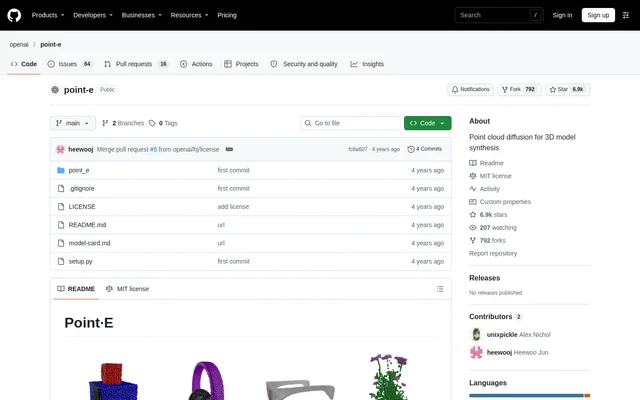
What is Point-e?
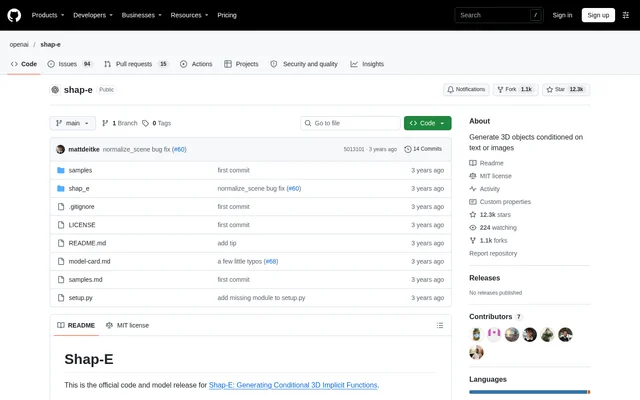
Point-e is an open-source project for 3D model synthesis using point cloud diffusion. OpenAI's repository contains the official code and model release associated with the work on generating 3D point clouds from complex prompts. Point-e is presented as a technical project with installation instructions, example notebooks, evaluation scripts, and sample downloads rather than a standalone design application.
Point-e supports exploration of different stages of a point cloud workflow: generating points from image or text input and producing meshes from those points. The repository makes these tasks available through separate examples, allowing developers and researchers to examine the generation and conversion paths.
What Point-e can do
Point-e provides generation examples, a mesh conversion model, and supporting research utilities. The documented capabilities distinguish image-conditioned point cloud sampling from direct text-based generation. The repository also includes evaluation scripts and rendering code, alongside downloadable assets corresponding to examples and evaluations discussed in the associated paper.
- Point-e samples point clouds conditioned on example synthetic view images.
- Point-e generates 3D point clouds directly from text descriptions.
- Point-e produces meshes from point clouds using an SDF regression model.
- Point-e includes P-FID and P-IS evaluation scripts.
- Point-e provides Blender rendering code.
- Point-e offers downloads of seed images and sample point clouds.
How Point-e works
Point-e documents installation with pip install -e . and directs users to example notebooks. The image2pointcloud.ipynb notebook samples point clouds conditioned on synthetic view images. The text2pointcloud.ipynb notebook demonstrates direct generation from text descriptions, while pointcloud2mesh.ipynb demonstrates the SDF regression model used to produce meshes from point clouds.
Point-e separates evaluation and rendering resources from these example notebooks. The repository identifies evaluate_pfid.py and evaluate_pis.py as evaluation scripts and blender_script.py as its Blender rendering code. These named resources provide concrete starting points for inspecting the documented workflows without implying a hosted service or an application interface.
Who Point-e is for
Point-e is relevant to developers and researchers who want to explore point cloud diffusion through code and model examples. The repository's notebooks suit experimentation with image-conditioned generation, simple text descriptions, and mesh conversion. The evaluation scripts and downloadable assets also support examination of the examples and evaluation resources associated with the research.
- Point-e supports experiments with point clouds generated from synthetic view images.
- Point-e supports tests of simple categories and colors in text prompts.
- Point-e supports exploration of point-cloud-to-mesh conversion.
- Point-e provides resources for studying P-FID and P-IS evaluation workflows.
Point-e pricing and access
Point-e is available as a free, open-source code and model release in a public GitHub repository under the MIT license. Access is documented through repository installation and example notebooks. The supplied GitHub plans and pricing information describes GitHub services, not Point-e subscriptions, and does not establish paid plans for this project.
Point-e strengths and limitations
Point-e combines official generation code and models with examples for mesh conversion, evaluation scripts, and Blender rendering code. The MIT license and downloadable sample assets make the release accessible for code-based exploration. The main documented model limitation concerns direct text-to-3D generation: the repository explicitly describes that model as small, lower quality, and limited in capability.
- Point-e's pure text-to-3D model understands some simple categories and colors but has limited capabilities.
- Point-e requires technical setup through installation and code-based examples.
- Point-e's documented image-conditioned example uses synthetic view images.
Point-e FAQ
What is Point-e?
Point-e is an open-source code and model release for generating 3D point clouds from complex prompts. The OpenAI repository includes image-conditioned and text-based generation examples, a point-cloud-to-mesh model, evaluation scripts, and Blender rendering code.
Is Point-e free?
Point-e is available as a free, open-source project under the MIT license in a public GitHub repository. The documented access path uses code installation and example notebooks; the source does not describe Point-e subscription plans.
Can Point-e generate 3D models from text?
Point-e includes a pure text-to-3D model that produces point clouds directly from text descriptions. The repository describes this model as small and lower quality, with limited capabilities, although the model understands some simple categories and colors.
Can Point-e convert point clouds into meshes?
Point-e includes an SDF regression model for producing meshes from point clouds. The repository directs users to pointcloud2mesh.ipynb to try this workflow, separately from the notebooks for image-conditioned and text-based point cloud generation.
How do you install and use Point-e?
Point-e documents installation with pip install -e . and provides notebooks for getting started. The examples cover sampling point clouds from synthetic view images, generating point clouds from text descriptions, and producing meshes from point clouds.
Does Point-e include evaluation and rendering tools?
Point-e includes evaluate_pfid.py and evaluate_pis.py for P-FID and P-IS evaluation, plus blender_script.py for Blender rendering. The repository also links downloads of seed images and point clouds corresponding to paper examples and seed images used for COCO CLIP R-Precision evaluations.
From the community
No reviews yet
Be the first to review this tool. What you write helps the next person choose.