What is ZBrain?
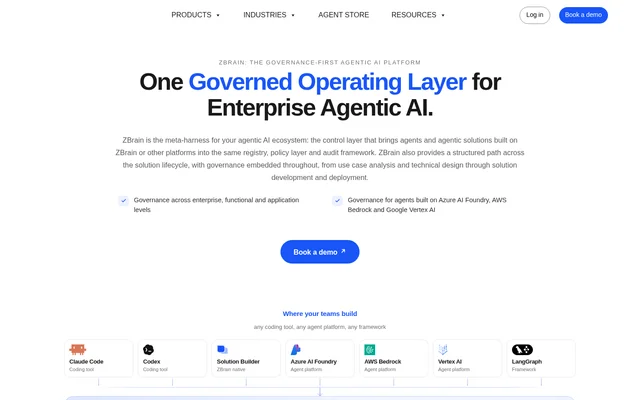
ZBrain is an enterprise agentic AI platform for governing deployed agents and developing agentic solutions. ZBrain brings agents built internally or on supported external platforms into a shared registry, policy layer and audit framework. ZBrain serves organizations that need defined permissions, approval processes, operational controls and accountability before agents execute work in production.
ZBrain applies governance at enterprise, functional and application levels. Enterprise policies establish organization-wide requirements, while functional controls add or tighten requirements for particular teams. Application controls apply inherited rules to individual agents and solutions, including runtime policy gates, confidence thresholds, approval requirements and audit trails.
What ZBrain can do
ZBrain combines agent governance with a development path from business use cases to deployed solutions. ZBrain evaluates governed actions before execution and records the resulting decisions. ZBrain also provides analysis, design and conversational building tools so that governance requirements remain part of the solution lifecycle rather than being added only after development.
- ZBrain registers agent owners, identities, approved tools, permitted data sources and operating scope.
- ZBrain allows, audits or blocks actions according to runtime policies.
- ZBrain routes actions below defined confidence thresholds to human reviewers.
- ZBrain enforces configured spending limits and approved model restrictions.
- ZBrain records decisions, actions and outcomes in tamper-evident audit trails.
- ZBrain generates technical designs containing requirements, workflows, architecture and integration context.
- ZBrain builds workflows, configures agents, connects systems and generates user interfaces.
- ZBrain provides a kill switch to stop all actions.
How ZBrain works
ZBrain begins the development path with ZBrain Analyzer, where AI agents collect and structure use-case context from functional team members. ZBrain Design turns that context into a technical design for stakeholder review. ZBrain Solution Builder then provides a conversational interface for building workflows, configuring agents, defining approvals, validating outputs and preparing deployment.
ZBrain can also onboard existing agents built on Azure AI Foundry, AWS Bedrock, Google Vertex AI, LangGraph, Google ADK, Microsoft Semantic Kernel and Microsoft Agent Framework without requiring a rebuild. ZBrain runs in the client's preferred cloud environment, tenant, region and security perimeter, using enterprise-selected models and endpoints with client-controlled keys.
Who ZBrain is for
ZBrain is intended for enterprises coordinating governance and agent development across organizational functions. ZBrain supports functional team members who explain business requirements, stakeholders who review technical designs and teams that build or operate agentic solutions. ZBrain also supports organizations that already have agents on supported platforms and need a common governance view.
- ZBrain supports shared policies across agents built on different supported platforms.
- ZBrain supports human approval for actions that require review.
- ZBrain supports tracing policies, approvals, exceptions and escalations through an audit view.
- ZBrain supports converting selected business use cases into deployed agentic solutions.
ZBrain pricing and plans
ZBrain lists an introductory Starter price of $999/month with a 7 days free trial and a Growth price of $5,994/6 months with a 15 days free trial. ZBrain offers Enterprise access through a demo. ZBrain lists custom SSO, unlimited builder users, unlimited integrations, deployment assistance, InfoSec review, API access and priority email support for Enterprise.
ZBrain describes credits as usage units that apply only to Growth. ZBrain charges a baseline of 5 credits per workflow execution, with additional consumption for certain external services. ZBrain lists no extra credits for external APIs using the client's own key and provider cost +20% for ZBrain-managed keys. ZBrain Enterprise does not require credits.
ZBrain strengths and limitations
ZBrain combines runtime controls, cross-platform agent onboarding and lifecycle governance within the same operating layer. ZBrain allows clients to retain their preferred cloud environment and control model keys. ZBrain Enterprise includes unlimited, unmetered essential tools, including workflows, knowledge bases, guardrails, model evaluation, data automation and prompt management.
ZBrain requires plan selection based on access and usage requirements: Starter and Growth are paid plans with time-limited trials, while Enterprise is available through a demo. ZBrain Growth introduces credit-based workflow consumption and potential additional service charges. ZBrain's stated external-agent onboarding coverage is tied to the supported platforms and frameworks named on the page.
- ZBrain Starter and Growth trials do not provide ongoing free access.
- ZBrain Growth usage can incur additional credits for third-party services.
- ZBrain Enterprise pricing is not published on the supplied page.
ZBrain FAQ
What is ZBrain?
ZBrain is an enterprise agentic AI platform that governs agent actions at runtime and supports use-case analysis, technical design and solution development. ZBrain combines an agent registry, policy controls, human approvals and audit trails across enterprise, functional and application levels.
Is ZBrain free?
ZBrain offers paid plans with free trials rather than a stated ongoing free plan. ZBrain lists Starter at $999/month with a 7 days free trial and Growth at $5,994/6 months with a 15 days free trial. ZBrain Enterprise is available through a demo.
Can ZBrain govern agents built on other platforms?
ZBrain can onboard agents built on Azure AI Foundry, AWS Bedrock, Google Vertex AI, LangGraph, Google ADK, Microsoft Semantic Kernel and Microsoft Agent Framework without requiring teams to rebuild those agents. ZBrain applies a shared governance layer and audit view to governed agents.
Where can ZBrain be deployed?
ZBrain runs in the client's preferred cloud environment, tenant, region and security perimeter. ZBrain works with enterprise-selected models, frameworks and endpoints, using keys controlled by the client, rather than requiring a single prescribed model or cloud environment.
How do ZBrain credits work?
ZBrain credits are usage units that apply only to the Growth plan. ZBrain charges 5 credits as a baseline for each workflow execution, with additional credits for certain external services. ZBrain Enterprise never requires credits, and external API calls using client-owned keys incur no extra credits.
Does ZBrain provide API access?
ZBrain lists API access in the published plan details, including Enterprise. ZBrain Enterprise also includes unlimited integrations, while ZBrain Solution Builder allows teams to connect systems as part of building agentic solutions.
From the community
No reviews yet
Be the first to review this tool. What you write helps the next person choose.