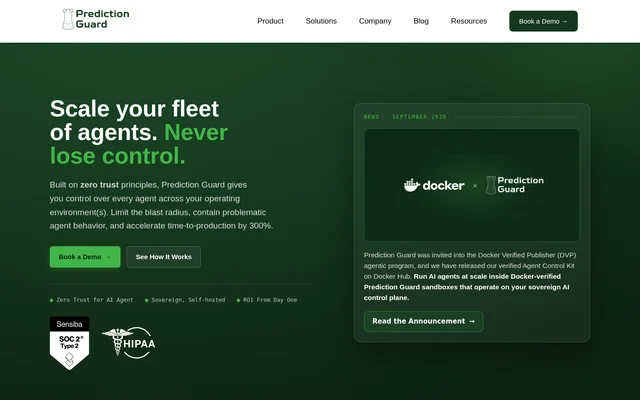
What is Prediction Guard?
Prediction Guard is a self-hosted control platform for enterprises operating AI agents. Prediction Guard places agent governance inside the organization's infrastructure, where runtime controls govern behavior rather than relying on users or agents to make policy decisions. Prediction Guard serves platform engineers, AI engineers, software vendors, and partners working with enterprise AI systems.
Prediction Guard combines an agent builder, a compatible API layer, and a control plane built on zero trust principles. Prediction Guard addresses agent behavior, supply chain management, observability, audit evidence, and token and spending enforcement. The control plane supports agents using either self-hosted models or cloud endpoint models.
What Prediction Guard can do
Prediction Guard combines agent creation with operational controls applied within the customer's security boundary. Prediction Guard includes capabilities for inspecting inputs and outputs, tracking agent components, and recording usage. The Regular offering includes Agent Forge, while Enterprise adds identity management, compliance evidence exports, and supply chain change management.
- Prediction Guard creates interactive and autonomous agents through Agent Forge.
- Prediction Guard provides PII masking, prompt injection checks, and toxicity checks.
- Prediction Guard scopes runtime controls per API key.
- Prediction Guard registers models, tools, and MCP servers.
- Prediction Guard records immutable audit logs and usage telemetry.
- Prediction Guard enforces token and spending controls.
- Prediction Guard Enterprise exports AIBOM and compliance evidence aligned to NIST AI RMF and OWASP.
How Prediction Guard works
Prediction Guard deploys its lightweight control plane inside the customer's infrastructure beside the agents. Prediction Guard exposes an OpenAI, Anthropic, and MCP-compatible API above that control plane, allowing developers to use supported tools and frameworks while the underlying runtime enforces policies. Named frameworks and tools include LangGraph, Pydantic AI, Crew AI, Claude Code, Hermes Agent, and OpenAI SDKs.
Prediction Guard Agent Forge accepts natural language prompts or API requests to create agents. Prediction Guard integrates key systems through MCP and tracks human and agent identities. Marketplace deployment descriptions cover Amazon Bedrock and self-hosted models in an AWS VPC, as well as Azure OpenAI and self-hosted models in an Azure tenant.
Who Prediction Guard is for
Prediction Guard targets the people building and operating enterprise AI, including platform engineers, AI engineers, software vendors, and partners. Prediction Guard positions Regular for engineering teams putting controlled agents into production. Prediction Guard Enterprise addresses organizations standardizing agent operations across business units, regions, and regulated environments.
- Prediction Guard helps platform teams enforce agent policies within their infrastructure.
- Prediction Guard gives AI engineers compatible API access with runtime controls.
- Prediction Guard supports software vendors embedding agent control.
- Prediction Guard Enterprise supports organization-wide governance and compliance evidence collection.
Prediction Guard pricing and plans
Prediction Guard Regular uses marketplace pricing billed through AWS or Azure, with current rates available in the respective listings. Prediction Guard Regular includes the self-hosted control plane, compatible API, supply chain registry, input and output controls, audit logging, Agent Forge, documentation, and email support. Eligible marketplace purchases can count toward existing cloud commitments.
Prediction Guard Enterprise uses custom annual agreements, volume pricing, and private marketplace offers. Prediction Guard Enterprise adds air-gapped and single-tenant deployment options, SSO, SAML, role-based access control, exportable compliance evidence, and supply chain change audit and rollback. Enterprise support includes a dedicated solutions engineer, guided onboarding, and priority support with a contracted SLA.
Prediction Guard strengths and limitations
Prediction Guard combines agent building, API compatibility, and runtime governance in a control plane that remains inside the customer's infrastructure. Prediction Guard supports both cloud endpoints and self-hosted models, while marketplace purchasing supports existing cloud procurement arrangements. Deployment responsibilities and the separation between Regular and Enterprise capabilities are practical considerations when evaluating the product.
- Prediction Guard requires an in-boundary control plane deployment in the customer's infrastructure.
- Prediction Guard lists current Regular rates through AWS or Azure Marketplace rather than on the supplied pricing page.
- Prediction Guard reserves air-gapped deployment and enterprise identity controls for Enterprise.
Prediction Guard FAQ
What is Prediction Guard?
Prediction Guard is a self-hosted AI agent control platform built on zero trust principles. Prediction Guard governs agent behavior, manages models and tools in an agent supply chain, records audit evidence, and enforces runtime policies inside the customer's infrastructure.
Is Prediction Guard free?
Prediction Guard is offered through paid AWS and Azure Marketplace listings, with current Regular rates available in those listings. Prediction Guard Enterprise uses custom annual agreements, volume pricing, and private marketplace offers for organization-wide deployments.
Does Prediction Guard support OpenAI and Anthropic APIs?
Prediction Guard provides an OpenAI, Anthropic, and MCP-compatible API above its control plane. Prediction Guard supports self-hosted models and cloud model endpoints, with named developer tools including LangGraph, Pydantic AI, Crew AI, Claude Code, Hermes Agent, and OpenAI SDKs.
Can Prediction Guard build AI agents?
Prediction Guard includes Agent Forge, a no-code agent builder for creating interactive and autonomous agents through natural language prompts or an API. Prediction Guard integrates key systems through MCP, tracks human and agent identities, and applies runtime behavioral policies.
Can Prediction Guard run in an air-gapped environment?
Prediction Guard Enterprise offers air-gapped and single-tenant deployment options. Prediction Guard Regular includes a self-hosted control plane deployed inside the customer's own cloud account, while Enterprise adds deployment options and enterprise identity controls such as SSO, SAML, and role-based access control.
What security controls does Prediction Guard include?
Prediction Guard includes PII masking, prompt injection checks, toxicity checks, and runtime controls scoped per API key. Prediction Guard also provides an agent supply chain registry, immutable audit logging, usage telemetry, and token and spending enforcement within the customer's infrastructure.
From the community
No reviews yet
Be the first to review this tool. What you write helps the next person choose.