What is CocoIndex?
CocoIndex is an open-source incremental engine for engineers building AI agents and LLM applications that depend on fresh context. CocoIndex converts sources such as codebases, meeting notes, inboxes, Slack, PDFs, and videos into data that agents can reason over. The project combines declarative Python workflows with a Rust engine.
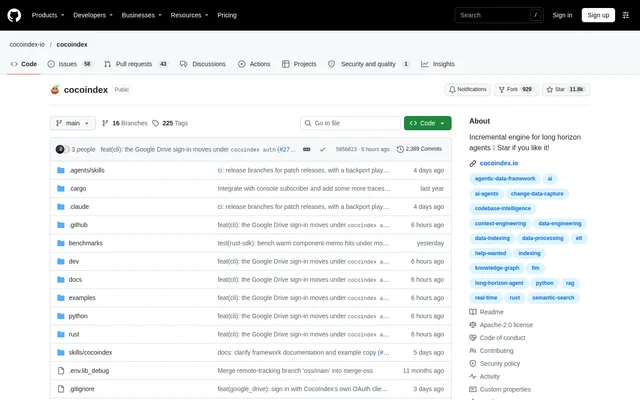
CocoIndex focuses on updating changed data rather than repeatedly processing an entire source. The repository describes this approach as a way to avoid stale batch pipelines and unnecessary re-embedding. CocoIndex is published on GitHub under the Apache-2.0 license, with documentation, examples, contribution guidance, and a community Discord.
What CocoIndex can do
CocoIndex maintains target data as upstream sources change. Engineers declare the desired target, while CocoIndex identifies affected records and reconciles the resulting updates. The repository demonstrates document indexing and describes broader change propagation across joins and lookups, alongside parallel processing and record-level failure isolation.
- CocoIndex recomputes only changed data.
- CocoIndex propagates changes across joins and lookups.
- CocoIndex updates targets and retires stale rows.
- CocoIndex splits document text into chunks for indexing.
- CocoIndex declares a vector index in the PostgreSQL example.
- CocoIndex isolates failures so a bad record does not stall the flow.
How CocoIndex works
CocoIndex is installed with pip install -U cocoindex and configured through Python code. The repository example walks a local directory, reads file text, splits the text into chunks, and declares target rows containing text and embeddings. CocoIndex mounts a PostgreSQL table target and declares a vector index on the embedding column.
CocoIndex runs an initial backfill before applying incremental updates on later runs. In the example, only changed files are re-embedded when the workflow runs again. CocoIndex also supports memoized functions cached by input and code hashes, connecting reuse of previous results to both the data and the transformation code.
Who CocoIndex is for
CocoIndex serves engineers developing AI workloads, especially agents and LLM applications that need changing source information reflected in their context. The repository presents examples as working starters that developers can adapt to their own sources. CocoIndex also supplies a coding-agent skill containing concepts, APIs, and patterns for generating CocoIndex code.
- CocoIndex supports codebase context workflows for AI agents.
- CocoIndex supports document indexing for LLM applications.
- CocoIndex supports incremental embedding updates from local files.
- CocoIndex supports target reconciliation when source records change.
CocoIndex licensing and access
CocoIndex is available as an open-source project under the Apache-2.0 license. Developers can obtain the project from its public GitHub repository or install the package through pip. The repository also introduces CocoIndex Enterprise for large corpora, but the supplied CocoIndex text does not state enterprise prices or plan terms.
CocoIndex strengths and limitations
CocoIndex combines incremental recomputation with parallel execution and a Rust core. The stated strengths include avoiding work on unchanged records, retiring stale target rows, and isolating failures. CocoIndex also provides examples and coding-agent guidance, while the documented workflow requires developers to write Python and configure the relevant sources and targets.
- CocoIndex requires a coded Python workflow in the documented setup.
- CocoIndex performs an initial backfill before subsequent incremental runs.
- CocoIndex does not state enterprise pricing in the supplied repository text.
CocoIndex FAQ
What is CocoIndex?
CocoIndex is an open-source incremental data engine for AI agents and LLM applications. CocoIndex turns sources such as codebases, documents, inboxes, and Slack into fresh context while processing changed data rather than repeatedly recomputing unchanged records.
Is CocoIndex free?
CocoIndex is available as an open-source project under the Apache-2.0 license through GitHub and pip. The repository also mentions CocoIndex Enterprise, but the supplied CocoIndex text does not provide enterprise pricing or plan terms.
How does CocoIndex keep data updated?
CocoIndex identifies affected records when a source changes, propagates changes across joins and lookups, updates targets, and retires stale rows. The documented workflow starts with a backfill, then reprocesses only changed data on subsequent runs.
How do you install CocoIndex?
CocoIndex can be installed with pip install -U cocoindex. The repository demonstrates configuring a declarative Python workflow that reads local files, splits text, declares embeddings, and writes to a PostgreSQL table with a vector index.
Does CocoIndex work with AI coding agents?
CocoIndex provides a skill for AI coding agents that covers CocoIndex concepts, APIs, and patterns in a single file. The repository points developers to its Use with AI coding agents instructions for installation steps.
From the community
No reviews yet
Be the first to review this tool. What you write helps the next person choose.