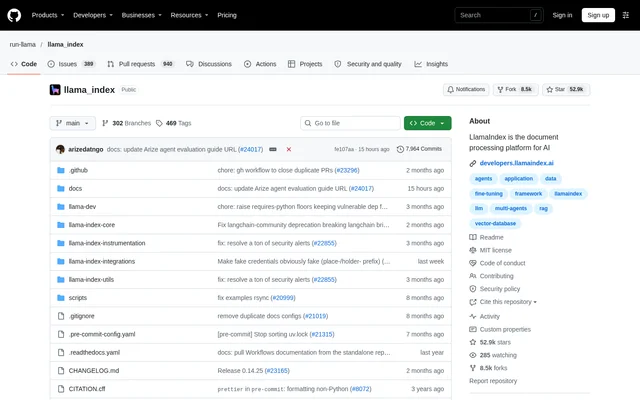
What is LlamaIndex?
LlamaIndex is an open-source framework for developers building agentic applications and retrieval-augmented generation systems. LlamaIndex provides tools for connecting private data to large language models, organizing that data and retrieving context for model responses. The repository describes the framework as a broad toolkit for RAG and agent applications, with interfaces for both beginner and advanced users.
LlamaIndex comes from the company behind LlamaParse. The repository explains that the company's primary focus has shifted toward document parsing, extraction and benchmarking, while the open-source framework remains available. LlamaParse is a separate document agent platform that can work with the framework or independently; its document-processing capabilities should not be confused with the framework's core functionality.
What LlamaIndex can do
LlamaIndex supports the data preparation and retrieval stages of LLM applications. LlamaIndex combines connectors, data structures and query interfaces so developers can supply models with context from existing sources. Lower-level APIs allow developers to customize individual modules rather than relying only on the high-level ingestion and query workflow.
- LlamaIndex ingests data from APIs, PDFs, documents and SQL sources.
- LlamaIndex structures data using indices and graphs.
- LlamaIndex retrieves context and returns knowledge-augmented output through a query interface.
- LlamaIndex exposes customizable retrievers, query engines and reranking modules.
- LlamaIndex supports saving indices to disk and reloading them.
How LlamaIndex works
LlamaIndex offers a starter Python package, llama-index, containing the core framework and selected integrations. LlamaIndex also offers llama-index-core for developers who prefer to install integrations separately. The repository lists over 300 integration packages covering LLM, embedding and vector store providers, and demonstrates packages for OpenAI, Ollama and Hugging Face embeddings.
LlamaIndex examples load documents from a directory, build a vector store index and create a query engine for questions. The OpenAI example sets an API key, while the Ollama example configures a model, tokenizer and embedding model. Index data stays in memory by default; developers can explicitly persist storage to disk and reload it later.
Who LlamaIndex is for
LlamaIndex serves AI developers who need to connect application-specific data with LLMs. LlamaIndex provides high-level APIs for beginners and lower-level APIs for advanced users who need to extend connectors, indices or retrieval components. The framework supports developers building RAG and agent applications rather than offering only a standalone document-processing interface.
- LlamaIndex supports question answering over private documents.
- LlamaIndex supplies retrieved context to LLM applications.
- LlamaIndex supports agentic application development.
- LlamaIndex enables custom retrieval and reranking workflows.
LlamaIndex pricing and access
LlamaIndex is available as an open-source project under the MIT license, with Python packages and source code linked from the repository. LlamaIndex framework access is separate from LlamaParse, which has its own signup and API key process. The supplied page does not state LlamaParse pricing or pricing for external model and infrastructure providers.
LlamaIndex strengths and limitations
LlamaIndex combines provider choice with separate high-level and low-level APIs, allowing developers to start with packaged integrations or customize framework components. LlamaIndex also documents disk persistence and examples using different model providers. Practical constraints include Python setup, explicit persistence configuration and documentation freshness: the repository warns that the README is updated less often than the main documentation.
- LlamaIndex requires Python package installation and application code.
- LlamaIndex stores data in memory unless disk persistence is configured.
- LlamaIndex development context includes a company focus shift toward LlamaParse and related document-processing efforts.
LlamaIndex FAQ
What is LlamaIndex?
LlamaIndex is an open-source framework for building RAG and agentic applications. LlamaIndex connects existing data sources to large language models through ingestion tools, indices, retrieval interfaces and integrations for model, embedding and vector store providers.
Is LlamaIndex free?
LlamaIndex is available as an open-source framework under the MIT license. LlamaIndex framework access is distinct from LlamaParse and external providers; the supplied repository text does not state pricing for those separate services.
What integrations does LlamaIndex support?
LlamaIndex provides over 300 integration packages for LLMs, embedding models and vector stores. LlamaIndex examples include OpenAI, Ollama and Hugging Face embeddings, and the overview names application-framework integrations such as LangChain, Flask, Docker and ChatGPT.
How do developers get started with LlamaIndex?
LlamaIndex offers the llama-index starter Python package or llama-index-core with separately installed integrations. LlamaIndex examples show loading documents, creating a vector store index and querying that index, with additional tutorials and references available in the documentation.
What is the difference between LlamaIndex and LlamaParse?
LlamaIndex is an open-source framework for RAG and agent applications, while LlamaParse is a separate platform for document agents, agentic OCR, parsing and extraction. LlamaIndex can be used with LlamaParse, but LlamaParse also works independently.
From the community
No reviews yet
Be the first to review this tool. What you write helps the next person choose.