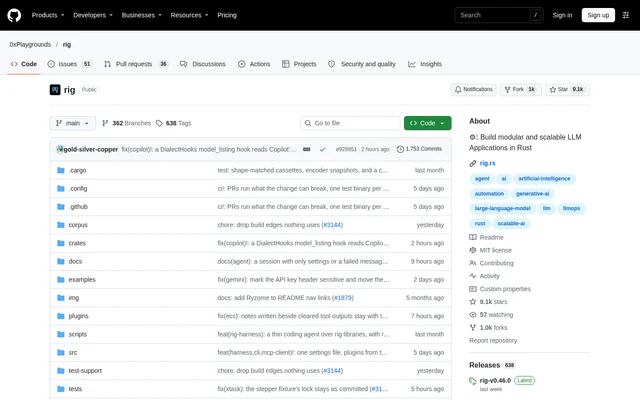
What is Rig?
Rig is an open-source Rust library for building LLM applications and a terminal coding agent built on that library. Rig gives developers shared interfaces for model providers, vector stores, tools, and conversations. The project separates its core abstractions, agent runtime, memory, coding tools, and terminal components into crates, allowing applications to use the components relevant to their workflows.
Rig's library supports application development, while the accompanying coding agent provides an interactive terminal workflow. The coding agent is a Bevy application whose tools, commands, sessions, sign-in, and terminal view are plugins. This architecture lets developers remove, replace, or add components rather than treating the agent as a fixed application.
What Rig can do
Rig combines model access, agent execution, and supporting infrastructure for LLM applications. The library includes completion, embedding, transcription, audio, and image-generation capabilities. Companion crates add conversation management, coding tools, and recording facilities. Integrations include AWS Bedrock, Google Vertex AI, LanceDB, MongoDB, PostgreSQL, Qdrant, SQLite, and other services listed in the repository.
- Rig builds agents with tools, multi-turn streaming, and typed hooks.
- Rig saves, resumes, forks, and compacts conversations.
- Rig records and replays agent effects with checkpoints.
- Rig provides read, write, edit, search, and shell coding tools.
- Rig supports GenAI semantic conventions for OpenTelemetry.
- Rig supports browser WASM for the core and agent runtime.
How Rig works
Rig can be added to a Rust project with cargo add rig, while the coding agent installs with cargo install rig-cli. Within the agent, /login connects a ChatGPT plan or saves a provider API key. Developers can also export a provider key before starting. The /model command selects an accessible model, including a configured local Ollama or llama.cpp server.
Rig supports interactive terminal use and scripted execution over pipes with JSON output. Plugin settings live in settings.toml. The /reload command rebuilds the agent with plugin crates and restarts the same session; the previous build continues running if compilation fails. Optional subagents and tools that operate on remote hosts over SSH or another command extend the coding workflow.
Who Rig is for
Rig is for Rust developers building language-model applications and developers who want an extensible terminal coding agent. The library covers model integration, tool use, streaming, and vector-store access. The agent's plugin guides address custom tools, commands, and panels, while its scripting interface supports workflows driven through pipes rather than the terminal view.
- Rig supports building agents that call tools and maintain conversations.
- Rig connects applications to embedding models and vector stores.
- Rig supports coding tasks such as fixing a failing test.
- Rig enables custom terminal-agent tools, commands, and panels.
Rig pricing and access
Rig is an open-source project distributed under the MIT license, with the library and coding agent obtained through Cargo. Model access is configured separately through a ChatGPT plan, a provider API key, or a local server. The repository provides documentation, examples, an API reference, an agent guide, and a plugin guide for implementation and setup.
Rig strengths and limitations
Rig's strengths include provider-neutral interfaces, modular crates, and a coding agent whose components can be changed through plugins. Recording and replay support agent-effect inspection, while local-server connections offer alternatives to hosted model access. Developers should also account for the repository's release warning, the terminal agent's operating-system requirements, and integrations that require explicit activation.
- Rig is pre-1.0, and releases contain breaking changes.
- Rig's coding agent requires Rust 1.97.1 or newer.
- Rig's coding agent runs on Linux and macOS.
- Rig's MCP client and ACP integration are off by default.
Rig FAQ
What is Rig?
Rig is an open-source Rust library for building LLM applications and a terminal coding agent built on that library. Rig provides model-provider interfaces, vector-store contracts, tool-using agents, streaming, and plugin-based coding workflows.
Is Rig free?
Rig is available as an open-source project under the MIT license. Rig's library and coding agent are obtained through Cargo, while model access is configured separately through a ChatGPT plan, provider API credentials, or a local server.
How do you install Rig?
Rig's library is added with cargo add rig, and Rig's terminal coding agent is installed with cargo install rig-cli. The coding agent requires Rust 1.97.1 or newer and runs on Linux and macOS.
Does Rig work with local models?
Rig's coding agent can select models from a local Ollama or llama.cpp server once the corresponding server URL or key is configured. Rig uses /model to choose among the models available through configured connections.
Does Rig support MCP and editor integrations?
Rig includes an MCP client for accessing MCP servers' tools and ACP support for clients such as Zed. Both integrations are off by default. The optional MCP plugin asks before starting a project's server.
Can you extend Rig's coding agent?
Rig's coding agent uses Bevy plugins for tools, commands, sessions, sign-in, and the terminal view. Rig allows these components to be enabled or disabled in settings.toml, and the plugin guide covers writing tools, commands, and panels.
From the community
No reviews yet
Be the first to review this tool. What you write helps the next person choose.