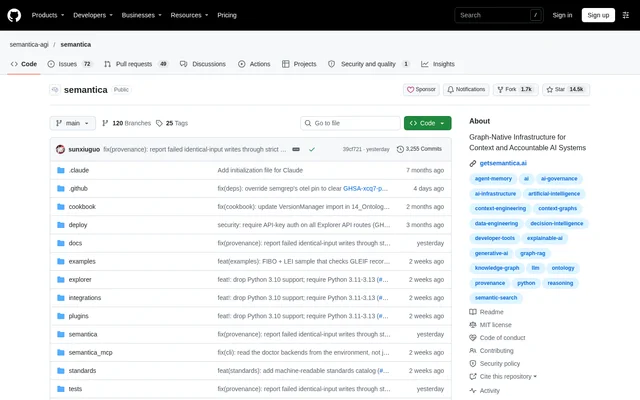
What is semantica?
semantica is an open-source semantic and context layer for AI systems that need structured knowledge and traceable decisions. semantica turns fragmented enterprise data into queryable context graphs and knowledge graphs, placing business definitions, relationships, and rules alongside the data. The project targets developers and enterprise teams working with consequential AI decisions, including organizations in finance, healthcare, legal, government, and defense.
semantica complements an existing LLM, vector store, or agent framework rather than replacing those components. Graph construction, reasoning, and provenance are deterministic and do not require an LLM. Optional language model support is vendor-neutral, with OpenAI, Anthropic, and Gemini named among the supported providers.
What semantica can do
semantica combines data preparation, knowledge modeling, reasoning, and decision records in an end-to-end pipeline. Independently importable modules cover ingestion through storage and export. Ontologies and controlled vocabularies make business meaning explicit, while provenance records connect facts and decisions to their sources. Graph analytics and an interactive browser workbench provide additional ways to inspect the resulting knowledge.
- semantica extracts entities, relationships, events, and triplets from source data.
- semantica flags conflicting facts and performs semantic deduplication before merging.
- semantica records decisions with causal ancestry, searchable precedents, and downstream impact.
- semantica applies SHACL constraints, OWL ontologies, and SKOS vocabularies.
- semantica runs centrality, community detection, link prediction, and shortest-path queries.
- semantica exports provenance to JSON, CSV, or RDF.
How semantica works
semantica installs through pip install semantica, and the quick start demonstrates importing ContextGraph from semantica.context. Developers create a graph, record a decision, trace its decision chain, find similar decisions, analyze impact, and check decision rules. The semantica doctor command verifies installation. The broader pipeline ingests sources, parses and normalizes content, extracts facts, resolves conflicts and duplicates, and builds the graph.
semantica connects to Databricks, Snowflake, and SAP OData, alongside sources such as files, web content, databases, and streams. Storage options include RDF stores, labeled property graphs, and vector stores. Integration paths include Agno, CrewAI, LangChain, a REST API, an MCP server, and a CLI.
Who semantica is for
semantica serves AI/ML platform teams building agents, enterprise data teams converting warehouse or lakehouse tables into governed graphs, and compliance teams investigating AI decisions. Infrastructure engineers can self-host the stack and swap storage backends. Data and knowledge engineers can use conflict detection and provenance-preserving merges when consolidating messy, multi-source information.
- semantica supports structured, shared context for agents making consequential decisions.
- semantica supports lineage-tracked knowledge graphs from enterprise data platforms.
- semantica supports decision investigations through provenance and execution trails.
semantica licensing and access
semantica is available as an open-source project under the MIT license, with source code hosted on GitHub. The repository provides a Python installation command, examples, documentation, and deployment files. Self-hosting is explicitly supported. The supplied page does not describe paid subscription plans or commercial pricing, so access is described through the open-source repository and package.
semantica strengths and limitations
semantica combines deterministic reasoning, source-linked provenance, ontology governance, and swappable storage within the same knowledge pipeline. These capabilities let teams retain their existing AI stack while adding structured decision records and audit trails. Explainability has a defined boundary: semantica explains the context, decisions, relationships, policies, and execution outside the model, not the model's internal reasoning.
- semantica does not expose or reconstruct foundation-model internals.
- semantica requires package installation and technical configuration for the demonstrated workflow.
- semantica's optional LLM integration does not make model internals transparent.
semantica FAQ
What is semantica?
semantica is an open-source, graph-native infrastructure project that builds context graphs and knowledge graphs from enterprise data. semantica combines deterministic reasoning, ontology governance, graph analytics, and decision provenance for teams building AI systems that need structured context and traceable decisions.
Is semantica free and open source?
semantica is available as an open-source project under the MIT license. semantica supports self-hosting and installation through pip install semantica. The supplied repository page does not list paid plans or subscription pricing.
Does semantica require an LLM?
semantica does not require an LLM for graph construction, deterministic reasoning, or provenance. semantica also supports optional, vendor-neutral language model integration through semantica.llms, with OpenAI, Anthropic, and Gemini named in the repository.
What integrations does semantica support?
semantica provides native connectors for Databricks, Snowflake, and SAP OData, plus integrations with Agno, CrewAI, and LangChain. semantica also exposes a REST API, MCP server, and CLI, and supports swappable RDF stores, labeled property graphs, and vector stores.
Can semantica explain why an AI made a decision?
semantica traces recorded decisions through provenance, causal relationships, relevant context, applied policies, and execution trails. semantica provides system-level explainability rather than foundation-model explainability, so semantica does not expose or reconstruct the internal reasoning of an LLM.
From the community
No reviews yet
Be the first to review this tool. What you write helps the next person choose.