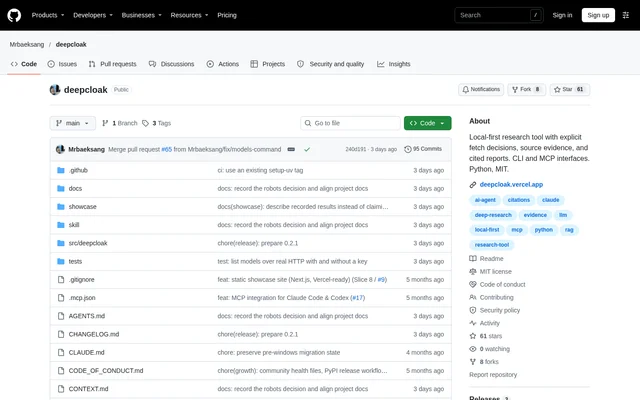
What is deepcloak?
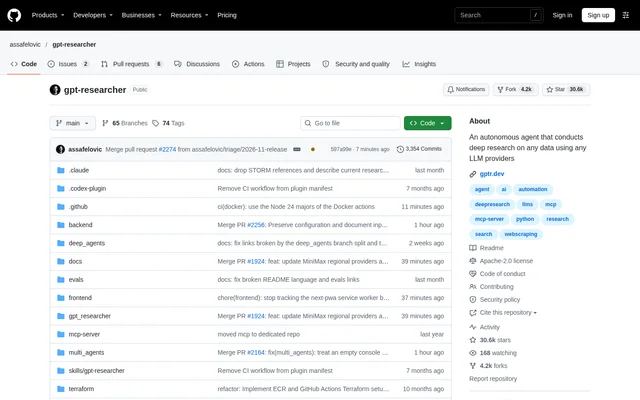
deepcloak is an open-source research tool that combines cited reports with explicit records of source-fetch decisions. deepcloak is designed for research workflows where missing or blocked sources need to remain visible. The Python project wraps local-deep-research for its research loop and CloakBrowser for browser-based retries, with CLI, MCP server, and Claude skill interfaces.
deepcloak records failures and skips rather than presenting only successfully retrieved material. Each URL receives an Evidence Record, and reports include the count of recorded bypasses. This evidence trail helps readers distinguish sources that were available from sources that remained inaccessible; successful retrieval still depends on the website and its access controls.
What deepcloak can do
deepcloak combines web research, selective browser fetching, and report generation in a local-first workflow. deepcloak attempts a plain fetch before escalating a detected bot wall to CloakBrowser, then checks whether the returned page is still a challenge. Research output includes citations and structured evidence that can be inspected separately from the report.
- deepcloak generates cited research reports.
- deepcloak records source failures, skips, and browser-retry outcomes.
- deepcloak exports an evidence JSON sidecar alongside a report.
- deepcloak exposes research and summary tools through MCP.
- deepcloak supports DuckDuckGo and SearXNG search.
- deepcloak saves completed runs for browsing and replay.
How deepcloak works
deepcloak installs with pip install deepcloak, followed by deepcloak setup to download the stealth browser. Users submit a research question through the CLI and can select research depth, output location, model provider, and model. DuckDuckGo provides search without setup, while configuration also supports SearXNG and alternative stealth-fetch settings.
deepcloak runs as a stdio MCP server for agent access, with configuration examples for Claude Code and Codex. The MCP tools cover deep research, quick summaries, evidence retrieval, and model listing. A separate Claude skill is also provided. Settings persist in a local configuration file, with CLI flags taking precedence over environment variables and saved configuration.
Who deepcloak is for
deepcloak serves researchers who need to examine source coverage and developers connecting research capabilities to AI agents. deepcloak is relevant when a report must show which pages were blocked or skipped rather than silently excluding them. Local model support also suits workflows where research context needs to remain on the machine.
- deepcloak supports cited web research with inspectable source evidence.
- deepcloak lets agent workflows request research and retrieve evidence.
- deepcloak enables review of saved reports and their run records.
deepcloak pricing and access
deepcloak is available as an open-source project under the MIT license, with installation through pip and source code on GitHub. deepcloak supports operation without an API key when using a local model. Supported provider options include Ollama, LM Studio, llama.cpp, OpenAI-compatible endpoints, and cloud providers configured through credentials.
deepcloak strengths and limitations
deepcloak makes source-access decisions inspectable and avoids launching a browser for every page by default. deepcloak honors robots.txt unless explicitly overridden and identifies itself on plain requests. Local-first operation does not mean all activity stays offline: search engines receive queries, source websites receive requests, and a configured cloud model receives research context.
- deepcloak browser retries can fail because source access controls vary.
- deepcloak requires local setup, including a stealth-browser download.
- deepcloak requires a local model when research context must remain on the machine.
- deepcloak leaves responsibility for access rights and lawful use with the user.
deepcloak FAQ
What is deepcloak?
deepcloak is an open-source, local-first research tool that generates cited reports and records source-fetch outcomes. deepcloak wraps local-deep-research and CloakBrowser, providing CLI, MCP server, and Claude skill interfaces for research workflows that need visible evidence of failures, skips, and browser retries.
Is deepcloak free?
deepcloak is available as an open-source project under the MIT license. deepcloak supports local-model operation without an API key and installs through pip. Cloud model providers are also supported through configured credentials; the source does not list deepcloak subscription plans.
Can deepcloak access websites behind bot walls?
deepcloak retries selected failed fetches in a stealth browser when a bot wall is detected. deepcloak re-checks the response and records a bypass only when the page is no longer a challenge. Successful access is not guaranteed and depends on the source and its access controls.
Does deepcloak work with Claude Code or Codex?
deepcloak connects to Claude Code and Codex through a stdio MCP server. deepcloak exposes tools for deep research, quick summaries, evidence retrieval, and model listing. The repository provides configuration examples and also includes a Claude skill for a slash-style workflow.
Does deepcloak keep research data local?
deepcloak runs its process locally, but search engines receive queries and source websites receive requests. deepcloak sends research context to a configured cloud LLM. Choosing a local LLM keeps that research context on the machine, without eliminating the external requests needed for web research.
From the community
No reviews yet
Be the first to review this tool. What you write helps the next person choose.