What is GPT Researcher?
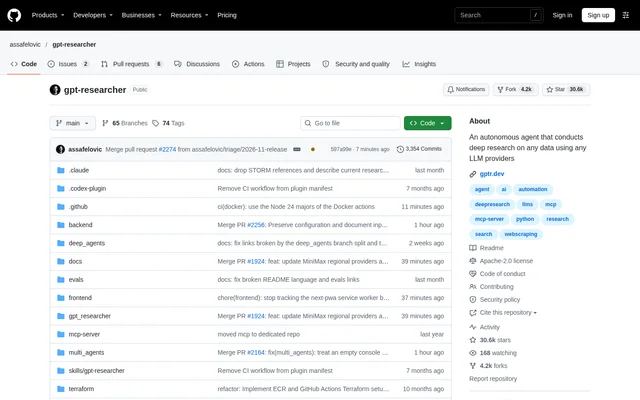
GPT Researcher is an open-source autonomous agent for researching questions using web sources and local documents. GPT Researcher produces reports with citations and offers customization for domain-specific research agents. The project serves individuals and organizations seeking factual information, with source code published on GitHub under the Apache-2.0 license.
GPT Researcher uses planner and execution agents rather than relying only on document retrieval. Research tasks become questions that guide information gathering, while a publisher combines the findings into a report. Multi-agent workflows coordinate specialized agents from planning to publication, and recursive research explores related subtopics.
What GPT Researcher can do
GPT Researcher combines source collection, context selection, report writing, and optional visual content within a research workflow. GPT Researcher can aggregate web evidence or work with supported local files, including spreadsheets, presentations, and text documents. Report outputs include citations, with export options for PDF, Word, and other formats.
- GPT Researcher generates research reports from web and local documents.
- GPT Researcher explores topics recursively with configurable depth and breadth.
- GPT Researcher scrapes JavaScript-enabled websites.
- GPT Researcher connects to specialized data sources through MCP.
- GPT Researcher filters collected passages before sending context to the LLM.
- GPT Researcher can generate inline illustrations using Google Gemini.
How GPT Researcher works
GPT Researcher begins with a research query and creates a task-specific agent. The planner generates research questions, and crawler agents collect information for those questions. GPT Researcher summarizes each resource, tracks its source, and filters the collected material before aggregating summaries into a final report.
GPT Researcher can run as a Python package or a local web application, with Docker instructions also provided. The documented installation requires Python 3.12 or later, dependencies, and API key configuration. Custom OpenAI-compatible API endpoints are supported. For local document research, users configure DOC_PATH and select the local report source.
Who GPT Researcher is for
GPT Researcher serves individuals and organizations conducting research across online information and local files. GPT Researcher also supports developers who want to integrate research into Python workflows or customize domain-specific agents. MCP connections extend these workflows to repositories, databases, and custom APIs alongside web search.
- Individuals can generate cited reports about a research question.
- Organizations can research collections of local documents.
- Developers can incorporate research and report generation into Python applications.
- Claude users can access research capabilities through the Claude Skill.
GPT Researcher pricing and access
GPT Researcher is an open-source project distributed under the Apache-2.0 license, rather than a listed subscription plan on this page. GPT Researcher is available through its repository and Python package, with Docker and Claude Skill installation paths. The page estimates deep research at ~$0.4 per research using o3-mini on high reasoning effort.
GPT Researcher strengths and limitations
GPT Researcher combines cited reporting, multiple research sources, and configurable agent workflows in an open-source project. GPT Researcher supports both browser-based use and programmatic research. Context filtering offers a local keyword fallback when a TypeSafe API key is absent or a Jev call fails, without requiring embeddings for that filtering step.
- GPT Researcher requires installation and configuration for the documented local deployment.
- GPT Researcher deep research can incur model usage costs.
- GPT Researcher requires a Google API key for optional Gemini image generation.
GPT Researcher FAQ
What is GPT Researcher?
GPT Researcher is an open-source autonomous research agent that produces reports with citations from web sources and local documents. GPT Researcher uses planning, information-gathering, and publishing agents, with customization options for domain-specific research tasks.
Is GPT Researcher free?
GPT Researcher is available as an open-source project under the Apache-2.0 license, but running research can involve API usage costs. The page estimates deep research at ~$0.4 per research using o3-mini on high reasoning effort.
Can GPT Researcher research local documents?
GPT Researcher supports research using local PDF, plain text, CSV, Excel, Markdown, PowerPoint, and Word files. Users configure DOC_PATH to point to their document folder, then select My Documents in the frontend or use the local report source in Python.
Does GPT Researcher support MCP integrations?
GPT Researcher supports MCP integration for research involving GitHub repositories, databases, and custom APIs alongside web search. GPT Researcher also has an MCP server in the dedicated gptr-mcp repository for AI applications such as Claude.
How do you install GPT Researcher?
GPT Researcher can be installed from its repository, used as a Python package, run with Docker, or added as a Claude Skill. The documented repository setup requires Python 3.12 or later, API keys, dependency installation, and starting the local server.
How does GPT Researcher filter research context?
GPT Researcher uses Jev when a TypeSafe API key is configured and falls back to local keyword ranking when the key is absent or a Jev call fails. GPT Researcher also offers embeddings and an option to disable filtering.
From the community
No reviews yet
Be the first to review this tool. What you write helps the next person choose.