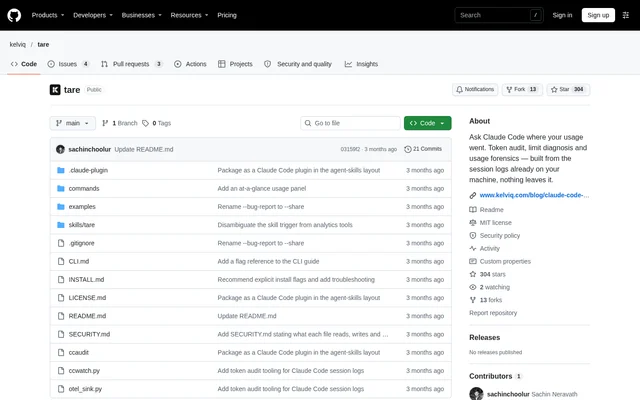
What is tare?
tare is an open-source Claude Code skill that explains token consumption and usage limits by analysing session logs already on a developer's computer. tare is intended for Claude Code users who need to understand unexpected quota drain, expensive sessions, or background activity. Rather than requiring a separate dashboard, tare lets users ask Claude Code questions about its own recorded requests.
tare focuses on the repeated context that contributes to session costs, not just the visible output of a request. tare uses existing records to explain where usage went and provide supporting evidence, checks, and suggested changes. The repository also includes example output showing a shareable summary and an HTML report.
What tare can do
tare combines token accounting with usage forensics to explain causes rather than present totals alone. tare can compare activity across periods, identify projects and models consuming quota, and examine the context added by tools, MCP servers, subagents, and skills. tare also distinguishes ordinary hands-on activity from patterns associated with automated sessions.
- tare deduplicates repeated API responses in Claude Code logs.
- tare attributes repeated context costs to the tool activity that caused them.
- tare reconstructs rolling-window usage at the moment of a lockout.
- tare identifies patterns of short, parallel automated sessions.
- tare generates HTML reports and privacy-redacted summaries.
- tare supports CSV export and live per-request telemetry through its scripts.
How tare works
tare installs through the terminal command npx skills add kelviq/tare -g -y --copy --agent claude-code. After installation, users start a new Claude Code session and check the slash-command menu for tare. Installation documentation also covers manual setup, team installation, and installation as a Claude Code plugin.
tare accepts ordinary questions about usage or explicit commands such as /tare, /tare usage, /tare window, and /tare week. tare reads local session records to produce a diagnosis or report. The included Python scripts make no network connections, and the security documentation describes what each file reads, writes, and sends.
Who tare is for
tare serves developers using Claude Code who want to investigate quota consumption without learning a separate reporting interface. tare also provides scripts for developers who prefer manual analysis, scripting, or cron-based workflows. The available questions cover both immediate limit diagnosis and comparisons intended to assess whether changes to a working setup affected usage.
- tare helps investigate why a usage limit interrupted a session.
- tare helps compare usage before and after changes such as using /clear.
- tare helps check for forgotten automations or overnight activity.
- tare helps prepare reports or redacted summaries for colleagues.
tare pricing and access
tare is distributed as an MIT-licensed open-source project on GitHub. The repository provides installation instructions rather than a commercial subscription plan for tare. The documented installation requires no additional accounts, packages, or configuration. tare depends on an existing Claude Code environment and Python, with alternative installation methods described in INSTALL.md.
tare strengths and limitations
tare combines local analysis, natural-language questions, and evidence-backed explanations of token consumption. tare provides shareable summaries containing totals, dates, and tool names while excluding prompts, file paths, contents, commands, and session or account identifiers. The main constraints concern supported environments and log sources, with an additional installation caveat documented for users who have never installed a Claude Code skill.
- tare currently reads Claude Code logs, not logs from other coding agents.
- tare requires Claude Code on macOS or Linux and Python 3.9+.
- tare installation can miss the skill when no Claude Code skill has previously been installed.
tare FAQ
What is tare?
tare is an open-source Claude Code skill for auditing token usage, diagnosing usage limits, and investigating session activity. tare reads existing local Claude Code logs so developers can ask plain-English questions about quota consumption, context overhead, and unexpected automation.
Is tare free?
tare is available as an MIT-licensed open-source project on GitHub. The repository documents installation without additional accounts, packages, or configuration, rather than a paid tare subscription. tare requires an existing Claude Code environment and a supported Python installation.
Does tare send session logs to an external service?
tare runs its analysis on the user's machine, and the included scripts make no network connections. tare also produces redacted sharing summaries that exclude prompts, file paths, file contents, commands, and session or account identifiers.
What does tare need to run?
tare requires Claude Code on macOS or Linux and Python 3.9+, with no Python packages to install. tare currently supports Claude Code logs only. The repository documents terminal installation, manual installation, team installation, and a Claude Code plugin option.
Can tare explain why a Claude Code usage limit was reached?
tare can investigate usage limits by reconstructing rolling-window activity and attributing token consumption to recorded requests and context. tare can identify expensive projects, repeated file context, and automation patterns, then provide evidence and suggested checks alongside the diagnosis.
What reports can tare export?
tare can generate an HTML usage report that opens in a browser, produce a redacted summary for public sharing, and export usage to a spreadsheet. tare also includes developer scripts with documented recipes for CSV export and live per-request telemetry.
From the community
No reviews yet
Be the first to review this tool. What you write helps the next person choose.