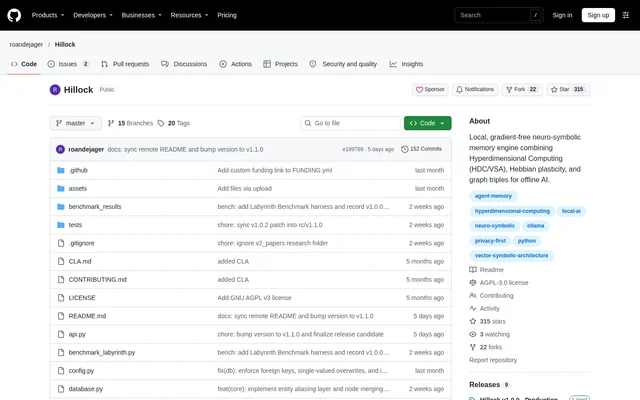
What is Hillock?
Hillock is an open-source neuro-symbolic memory engine for local, offline AI applications. Hillock combines hyperdimensional computing, Hebbian plasticity, and a SQLite knowledge graph to retrieve factual relationships before a language model generates an answer. Hillock targets developers working with local assistants, autonomous agents, and edge hardware.
Hillock checks whether an entity and the requested relationship are supported by stored memory. When those checks fail, Hillock blocks the generation path and returns a refusal rather than supplying unrelated context to a model. This makes verified relationships, rather than nearest-neighbor text chunks alone, central to the documented workflow.
What Hillock can do
Hillock provides document ingestion, structured memory, retrieval checks, and interfaces for local applications. Hillock uses GLiREL Large and an ONNX-runtime MiniLM router to extract factual links into SQLite. Hillock also maintains concept associations that strengthen through co-occurrence and decay when inactive, alongside explicit subject-predicate-object facts.
- Hillock extracts facts from text and PDF documents.
- Hillock merges alternate entity names through aliases.
- Hillock displays stored facts and Hebbian association weights.
- Hillock checks concept similarity and predicate alignment before generation.
- Hillock exposes streaming OpenAI-compatible chat completions.
- Hillock switches local Ollama models from the console.
- Hillock retrieves verified facts directly through Python without an LLM.
How Hillock works
Hillock stores facts as structured triples in SQLite with Write-Ahead Logging and safeguards for single-valued relationships. Hillock represents concepts and relations with bit-packed hypervectors and performs similarity checks using CPU operations. The retrieval gate evaluates similarity and predicate alignment before allowing the language-model generation path to continue.
Hillock can be installed through PyPI or from the repository, with launch scripts for Windows, Linux, and macOS. The documented setup requires Python 3.10+ and a spaCy language model. Ollama runs locally for model-backed use but is optional in headless mode. Hillock starts its API with python api.py and its console with python main.py.
Who Hillock is for
Hillock is for developers who need local factual memory for assistants, agents, or custom scripts. Hillock supports consumer laptop CPUs without requiring an NVIDIA card. Developers can connect external interfaces through the OpenAI-compatible API or use the Python engine directly when an application needs structured facts rather than generated prose.
- Hillock supports document-grounded questions over ingested text and PDFs.
- Hillock supplies verified factual memory to autonomous agent scripts.
- Hillock connects local memory to AnythingLLM and Open-WebUI.
- Hillock supports inspection of entity facts and learned concept associations.
Hillock pricing and plans
Hillock is dual-licensed under AGPL-3.0 and a commercial license. Hillock offers a Startup Commercial License through Polar for $49/month, including an AGPL-3.0 exemption, commercial indemnity, and direct support for architecture review and deployment guidance. Enterprise arrangements for custom SLAs, high-volume deployments, or invoice billing are available by email.
Hillock requires a commercial license for closed-source products, proprietary SaaS, or commercial setups that do not release application source code under AGPL-3.0. Hillock can otherwise be obtained as open-source code through the repository or installed from PyPI. Contributors must sign a Contributor License Agreement when opening a pull request.
Hillock strengths and limitations
Hillock combines offline operation, CPU-based retrieval, explicit factual checks, and interfaces for both model-backed and headless applications. Hillock includes reproducible verification and evaluation scripts for database constraints, memory behavior, retrieval, and negative controls. However, the README states that standardized public benchmark runs and comparative charts are still being prepared.
- Hillock needs local installation and dependency setup.
- Hillock refuses questions when supporting factual relationships are missing.
- Hillock requires commercial licensing for proprietary use without AGPL-3.0 source disclosure.
- Hillock has not yet published the described standardized public benchmark comparisons.
Hillock FAQ
What is Hillock?
Hillock is an open-source, local neuro-symbolic memory engine for offline AI. Hillock combines a SQLite knowledge graph, Hebbian associations, and hyperdimensional computing to store factual relationships and check supporting evidence before allowing a language model to generate an answer.
Is Hillock free?
Hillock is available as open-source software under AGPL-3.0, with a separate Startup Commercial License priced at $49/month through Polar. Hillock requires commercial licensing for proprietary deployments that do not release application source code under AGPL-3.0, and enterprise licensing is available by email.
Can Hillock run without a GPU or language model?
Hillock runs its memory and retrieval engine on consumer laptop CPUs without requiring an NVIDIA card. Hillock also supports a headless Python mode that retrieves verified facts without an LLM, making Ollama optional for that workflow.
Does Hillock work with AnythingLLM and Open-WebUI?
Hillock connects to AnythingLLM and Open-WebUI through a built-in FastAPI server exposing an OpenAI-compatible chat completions endpoint with streaming support. Hillock documents starting the server with python api.py and configuring the external interface to use the local OpenAI-compatible base URL.
How does Hillock handle questions without supporting facts?
Hillock blocks the generation path when a question lacks a verified entity or matching factual relationship in memory. Hillock then returns a refusal instead of sending unsupported context to the language model, as demonstrated by the README's missing pet relationship example.
How do you install Hillock?
Hillock can be installed through PyPI, repository launch scripts, or manual source setup. Hillock requires Python 3.10+ and documents downloading the spaCy en_core_web_sm model. Windows uses run.bat, while Linux and macOS use run.sh; Ollama is optional for headless operation.
From the community
No reviews yet
Be the first to review this tool. What you write helps the next person choose.